


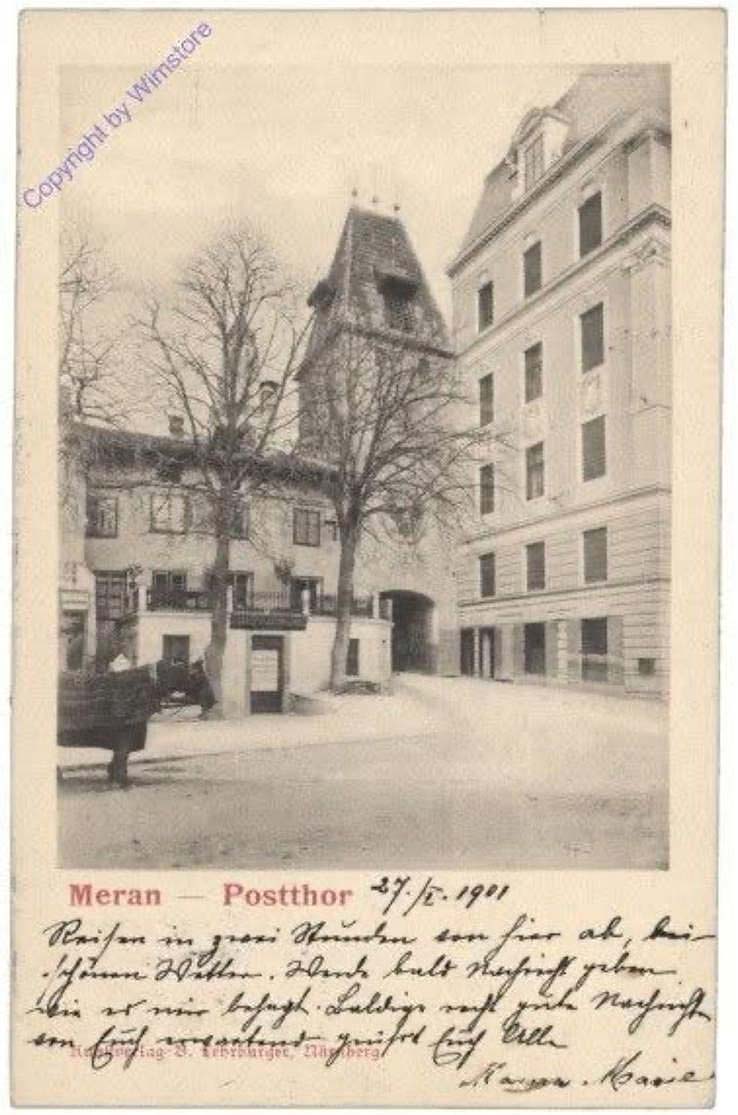
The City Gates of Meran and the Bozner Tor
When Meran was elevated to a city in the 13th century, the Counts of Tyrol built the city wall with originally four (city) gates. Today, only three remain: the Bozner Tor, the Vinschger Tor, and the Passeirer Tor. The fourth, the Ultner Tor, was demolished in the 19th century as part of urban redevelopment.
All the gates have a tower-like structure and are oriented towards the valleys and cities that gave them their names. The Bozner Tor is particularly beautiful, with its striking, steep roof. The facade features the relief coats of arms of Meran, Tyrol, and Austria. It stands on the Sandplatz and leads directly into Meran's spa district. This is where the history of Restaurant Sigmund began.
The Beginnings in the 1930s
In the 1930s, Anna and August Sigmund, the grandparents of the then owners, acquired the house adjacent to the Bozner Tor. At that time, it was still used as a butcher's shop. The family converted the building into an inn and laid the foundation for Restaurant Sigmund, which soon became a popular meeting point. Over the decades, the business was run by the family, later rented out for a few years, but it always remained closely associated with the name Sigmund.
From Family Business to New Generation
After the Sigmund and Hölzl era, Restaurant Sigmund was taken over by the Steiner family in 2024, with tradition being preserved while new impulses are being set.
The Major Renovation in 2013
Over the decades, the ravages of time had taken their toll on the historic building, which was probably built in the 14th century. Economic operation was hardly possible, so the family decided on a extensive renovation.
Under the direction of architect Wolfram Pardatscher, in close consultation with the heritage office and restorer Stefan Wörz, the house was renovated in 2013. All later additions were removed and historic elements such as stone walls, wooden ceilings, stairs, windows, and doors were carefully preserved.
The room on the first floor with frescoes and furniture from the 1930s was restored to its original state.
The Henkersstube, whose paneling and furnishings were once acquired by August Sigmund in Tscherms, was restored to its original appearance.
In the cellar, medieval stone walls and the 1304-mentioned city wall were exposed. The stream running under the guest room was enclosed in a steel casing.
On the south facade, the fresco of the "Black Madonna" from 1741 was restored.
On the back, a lime painting from the 17th century, a Gothic window opening, and two arched passages came to light, which are now glazed.
A new internal staircase now connects all floors. Four guest rooms were created on the upper floors, two with a terrace and a view of the old town and Tappeinerweg.
The two over hundred-year-old horse chestnuts in front of the house, which could no longer be saved, had to be felled and were replaced by young, six-meter-high trees.
After just six months of construction, Restaurant Sigmund shone in new splendor – as a successful blend of medieval substance and contemporary architecture.
A Place with History and Future
Today, Restaurant Sigmund is a house that unites past and present: building rich in tradition at the Bozner Tor, where history, hospitality, and enjoyment come together in a special way.